Why Marvel Snap is a Masterclass in Cutting the Creative Fat Out of the Competitive Card Game
For decades, the collectible card game (CCG) genre was defined by a philosophy of expansion and accumulation. To play a traditional match of Magic: The Gathering or Yu-Gi-Oh!, you had to accept a massive, slow-moving logistical contract.
Games routinely stretched across forty-five minutes, bogging players down in endless shuffling phases, tracking complex resource pools, reading blocky paragraphs of card text, and waiting out grueling opponent turn-timers. The barrier to entry was high, and the downtime was immense.
When Ben Brode and the team at Second Dinner set out to design a modern CCG, they didn’t just tweak the existing blueprint; they took a chainsaw to it. They looked at the genre’s legacy and asked a radical question: How much creative fat can you cut before a competitive card game collapses?
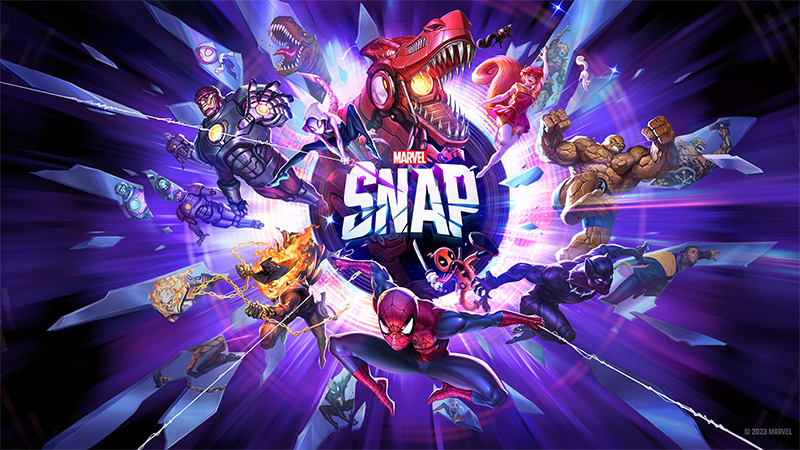
The answer is Marvel Snap.
By compressing the strategic weight of a sprawling tabletop card match into a hyper-fast, three-minute mobile blitz, Marvel Snap has established itself as an absolute masterclass in elegant game design. It strips away the traditional bloat of the genre and replaces them with an incredibly tight three-lane location matrix and a high-stakes psychological doubling mechanic. The result is a beautifully minimalist competitive sandbox that turns your daily bus commute into a brutal, lightning-fast masterclass in game theory.
The Anatomy of Abundance: Deconstructing Deck Bloat
To understand how drastically Marvel Snap streamlines the card game experience, one must first look at the mathematical composition of its decks. In Magic, players construct decks containing at least sixty cards, with nearly a third of that real estate dedicated purely to resource generation (Land cards). In Hearthstone, the standard deck size is thirty.
Large decks introduce massive statistical variance. They force players to sit through frustrating matches where they simply fail to draw their core win conditions, leading to dead hands and anti-climactic losses driven entirely by bad luck.
Marvel Snap completely eradicates deck bloat by enforcing a rigid, non-negotiable rule: your deck must contain exactly twelve cards. There are no resource cards mixed into the pile. Instead, energy automatically increments by $+1$ at the start of each turn, capping at a maximum of six.
Furthermore, every match lasts exactly six turns. Because players draw three cards at the start of the game and one additional card each turn, you will naturally see exactly nine out of your twelve cards in every single match.
This simple mathematical adjustment completely alters the psychological landscape of card play. By reducing deck size to twelve, Second Dinner has practically eliminated the traditional frustration of the “bad draw.” Players possess absolute, near-perfect consistency.
You can engineer incredibly tight, synergistic engine loops, secure in the knowledge that your win conditions will almost always manifest in your hand. The game eliminates the tedious filler fluff of drawing, searching, and tutoring, ensuring that every single card you play carries an immediate, high-impact tactical weight.
The Three-Lane Location Matrix: Eliminating the Battlefield Bottleneck
In a traditional CCG, combat is a linear, often suffocating bottleneck. Players summon creatures onto a single, shared battlefield, resulting in massive, convoluted board states where dozens of minion abilities interact simultaneously, grinding the game’s pacing to a crawl.
Marvel Snap shatters this bottleneck by borrowing a concept from tactical board games: the Three-Lane Location Matrix.
To win a match, a player does not attack their opponent’s life total. Instead, they must secure the highest cumulative power score in at least two out of the three distinct lanes randomly generated on the screen. Each lane can only hold a maximum of four cards per player, placing a massive, claustrophobic premium on spatial real estate.
What makes this system a stroke of pure mechanical genius is the dynamic variability of the locations themselves. Drawn from a pool of hundreds of iconic Marvel locales, each location features a unique game-warping rule revealed sequentially over the first three turns. One location might completely destroy any card played there; another might double all ongoing power values or invert the energy costs of your hand.
This environment transforms the game from a stale exercise in memorized, meta-deck optimization into a live, reactive tactical scramble. You cannot simply execute a rigid, pre-planned sequence of plays. You must dynamically adapt your strategy on the fly to the hostile, unpredictable topography of the board.
The three-lane structure distributes the tactical focus, forcing players to play a high-speed game of mental chess across multiple fronts simultaneously, eliminating any possibility of a stagnant board state.
The “Snap” Feature: The Integration of Poker Psychology
The absolute crown jewel of Marvel Snap’s design framework—and the mechanic that elevates it from a casual mobile distraction to a cutthroat psychological thriller—is the eponymous Snap button.
In traditional competitive games, ranking points (or “Cubes” in Snap) are awarded via a flat, binary outcome: you win a match and gain a fixed amount, or you lose and drop a fixed amount. This system forces players to sit through miserable, slow-burning losses where an opponent has clearly locked down the board, leading to a lingering feeling of resentment and wasted time.
The Snap feature imports the psychological doubling mechanics of Poker directly into the digital card framework. At any point during the six-turn match, if a player feels absolute confidence in their board state or if they want to execute an audacious, high-risk bluff, they can tap the Cosmic Cube at the top of the screen to “Snap.”
This instantly doubles the ranking stakes of the current match. If the opponent stays in the game rather than retreating, the stakes double again automatically on the final turn, escalating a standard 1-Cube match into a high-octane, 8-Cube meatgrinder.
This mechanic completely re-engineers how players internalize victory and defeat. The ultimate skill in Marvel Snap is no longer just playing your cards mathematically perfectly; it is risk mitigation.
If your opponent Snaps and you realize your hand cannot counter their setup, the game explicitly rewards you for clicking the “Retreat” button. Retreating allows you to immediately concede the match, sacrificing a single Cube to preserve your rank, rather than bleeding points in a hopeless fight.
By turning the act of folding into a core, highly strategic mechanic, Second Dinner has eliminated the toxic frustration of the un-winnable match. The meta-game stops being about achieving a flawless 100% win rate and refocuses entirely on maximizing your point gains when you hold the upper hand, and minimizing your losses when the RNG shifts against you.
Zero Downtime: Simultaneous Turns and Structural Flow
The final piece of fat sliced from the CCG skeleton is the concept of sequential turns. In almost every major trading card game, Turn 1 belongs entirely to Player A, while Player B sits in passive silence, staring at the screen until their opponent finishes their calculations.
Marvel Snap completely abolishes this mechanical segregation by utilizing Simultaneous Turns.
Both players look at the board, calculate their options, and place their cards concurrently during a brief, hidden 30-second window. Once both players hit the “End Turn” button, the cards are revealed and resolved in real-time based on a simple priority metric (the player currently winning the board reveals their cards first).
This design choice creates a seamless, rapid flow-state with absolutely zero downtime. There is never a moment where you are disconnected from the action, waiting for an opponent to slowly browse their hand. Because the turn happens simultaneously, you are constantly engaged in an active, real-time guessing game, trying to predict exactly where your opponent is going to commit their power resources across the three lanes. The game loops are so compressed and immediate that a player can finish an entire, multi-turn competitive match, gain ranking points, adjust their deck, and queue into a brand-new game in the time it takes an * Hearthstone* player to finish their opening mulligan phase.
The Masterclass in Digital Minimalism
Marvel Snap stands as a defining monument to the power of digital minimalism in an industry often obsessed with over-complication and artificial inflation. Second Dinner looked at a thirty-year-old genre weighed down by the heavy, nostalgic baggage of physical tabletop rules and had the creative courage to reinvent it entirely for the realities of modern mobile play.
They proved that you do not need sixty-card decks, forty-minute play clocks, complex mana mathematics, or convoluted combat boards to craft a deeply competitive, intensely satisfying strategic experience.
By stripping away the creative fat and engineering a system built on twelve-card consistency, three-lane tactical spatial awareness, and the high-stakes human psychology of the poker bluff, Marvel Snap has set a towering new benchmark for game design efficiency. It is a sleek, hyper-optimized engine of pure digital adrenaline—a reminder to developers across the globe that sometimes, the most revolutionary thing you can do to a classic game formula is simply cut everything else away.