Dropping Off 70-Foot Red Rock Cliffs: How MTB Freeriders Build Their Own Stairways to Heaven
Here is my take: human beings have built an entire global industry around making sports safe, standardized, and neatly packaged.
We paint bright white lines on perfectly manicured green grass. We construct indoor stadiums with climate-controlled domes so a slight drizzle doesn’t ruin the game. We pour smooth, predictable concrete skateparks, smooth out ski slopes with giant snow-cat grooming machines, and install soft foam pads around the edges of tracks so nobody hurts themselves when they make a mistake. We love the illusion of an even playing field where every variable is controlled and every surface is engineered for human safety.
And then there is Virgin, Utah.
If you drive out into the harsh, sun-baked badlands of southern Utah, about twenty miles outside of Zion National Park, you won’t find manicured fields, safety nets, or smooth concrete. You will find a brutal, ancient landscape of vertical sandstone cliffs, razor-sharp exposed knife-edges, crumbling red dirt, and sheer three-hundred-foot drops into jagged boulder fields. It is a terrifying, prehistoric wasteland that looks more like the surface of Mars than a sporting venue. It is a place where nature explicitly tells human beings to stay away.
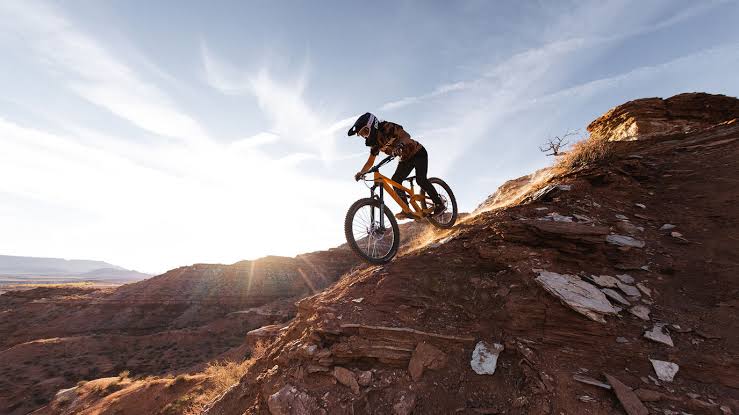
Yet, once a year, the absolute gnarliest mountain bikers on planet Earth gather in this desert, strap on full-face helmets, look down a vertical seventy-foot cliff face that would make a rock climber sweat, and decide to drop in on a full-suspension bicycle.
This is the world of freeride mountain biking, anchored by its ultimate, legendary crown jewel: Red Bull Rampage.
To anyone watching from the bottom of the canyon, what these athletes do looks like complete, unhinged insanity. You are watching a human being launch off a natural sandstone shelf the height of a seven-story building, flips upside down over a seventy-foot canyon gap with nothing beneath them but empty air and jagged rocks, lands on a landing pad the width of a sidewalk, and immediately navigates a five-foot-wide knife-edge ridge with a hundred-foot drop-off on either side.
There are no paved tracks here. There are no pre-built wooden courses provided by an event committee.
Before a rider even swings a leg over their bike, they spend a full week out in the hundred-degree desert heat with two diggers, armed with nothing but shovels, pickaxes, sandbags, and a wild imagination. They literally dig their own lines out of the mountain face. They carve raw ramps into sheer rock, stack dirt to build landing pads, and hand-craft their own personal, terrifying stairways to heaven.
It is an absolute mind melt. Freeride mountain biking at Red Bull Rampage is not just an extreme sport; it is secretly the ultimate fusion of raw human creativity, structural dirt engineering, extreme mountain physics, and mind-bending psychological grit.
Let us hike up into the dust of the Utah desert, break down the crazy physical mechanics of digging a line on a vertical ridge, explore the high-stakes physics of suspension and air-time, and dive deep into the fearless mentality required to drop off a cliff on two wheels.
The Canvas of Dust: The Raw Art of Line Building
To truly understand what makes freeride mountain biking different from every other cycling discipline on the planet, you have to throw out the idea of a pre-set course.
In Olympic cross-country or World Cup downhill racing, the organizers tape off a track. Every rider rides the exact same rocks, the exact same roots, and the exact same berms. The winner is simply the person who can push their heart rate to the absolute limit and execute that pre-determined track a fraction of a second faster than everyone else.
At Rampage, there is no tape. There is only a raw, terrifying mountain face.
When the riders and their two-person dig crews arrive in Virgin, Utah, a week before the event, they stand at the base of the mountain and look up at a chaotic labyrinth of cliffs, chutes, ridges, and canyons. The event organizers give them a simple set of rules: pick a path from the top of the peak to the finish arch at the bottom, stay within the general boundaries of the venue, and don’t use power tools or heavy machinery. Everything must be built by hand.
This turns every freerider into part athlete, part sculptor, and part structural engineer.
A rider looks up at an intimidating, unridden section of vertical rock—a feature that everyone else has written off as un-rideable—and sees a hidden path. They might see a way to build a step-down drop off a natural sandstone ledge, carve a high-speed wooden-supported berm across a steep slope, and connect it directly to a massive gap jump over a deep canyon.
The physical labor of building a line is exhausting, back-breaking work. For eight to ten hours a day, under a scorching desert sun, riders and their crews haul heavy sandbags up sheer cliffs, hack away at stubborn sandstone with pickaxes, and carry five-gallon buckets of water up steep gullys to pack down dry dirt.
Water is the gold of the desert when building a freeride line. Dry desert dirt acts like loose flour; if you try to land a heavy bicycle on it, your tires will sink in, wash out, and send you flying over the handlebars into the rocks.
To turn that loose flour into a rock-solid, concrete-like landing ramp, the diggers must meticulously mix water into the clay, compact it layer by layer with their shovels and feet, and let the desert heat bake it solid.
Every jump lip must be shaped with mathematical precision. If a takeoff ramp is built half a degree too steep, it will pop the rider too high into the air, causing them to overshoot the landing pad and flat-bottom onto solid rock from forty feet up. If the takeoff is too flat, the rider won’t carry enough height to clear the canyon gap, slamming directly into the opposite rock wall.
When you watch a freerider drop into their run, you aren’t just watching their athletic talent. You are watching a physical manifestation of their personal vision, built out of their own blood, sweat, and calloused hands.
Gravity, Mass, and Shock Waves: The Physics of Massive Air
Once the lines are carved and the dirt has baked rock-solid in the sun, the stark physical reality of gravity takes center stage.
When a freerider drops off a seventy-foot cliff or launches over a seventy-five-foot canyon gap, they are operating at the extreme limits of mechanical physics. They are translating forward momentum down a steep incline into massive vertical amplitude, placing astronomical forces on both their equipment and their human bodies.
Consider the math of dropping off a cliff on a bicycle.
As a rider rolls toward the edge of a seventy-foot drop, potential energy converts rapidly into kinetic energy. Gravity accelerates the rider toward the earth. By the time the rider reaches the bottom of that vertical freefall, they are traveling at speeds well over forty-five miles per hour in a downward vector.
When that rider slams back into the ground, that massive kinetic energy has to go somewhere.
If the rider lands on a completely flat surface, the deceleration force is practically instantaneous. The energy would shatter the aluminum frame of the bike, snap the steel axles, and send shockwaves straight through the rider’s ankles, knees, and spine, causing severe internal injuries.
To survive these terrifying drops, freeriders rely on two crucial buffers: Landing Gradient Angle and Advanced Suspension Mechanics.
First, freeriders never drop onto flat ground. They build landing ramps on steep, thirty-five to forty-five-degree slopes. By matching the angle of the landing ramp to the natural parabolic trajectory of the rider’s flight path, the downward force isn’t stopped dead in its tracks. Instead, the vertical impact force is converted smoothly back into forward momentum, allowing the rider to roll away at high speed like a jet landing on an aircraft carrier runway.
Second, there is the incredible technology of modern freeride bikes.
A downhill freeride mountain bike is a masterpiece of heavy-duty mechanical engineering. These bikes feature long-wheelbase alloy or carbon frames equipped with dual-crown suspension forks up front and heavy-duty coil shocks in the rear, delivering around eight inches (200 millimeters) of vertical wheel travel.
When a rider impacts a landing, the suspension system compresses violently. High-speed hydraulic damping oil is forced through microscopic valves inside the shock absorbers, converting the kinetic shock energy of the jump into thermal heat inside the shock oil.
The tires—massive two-point-six-inch wide rubber casings running low air pressure—deform around rocks to maximize traction and absorb high-frequency chatter.
It is a miracle of mechanical engineering. The bike absorbs thousands of pounds of instantaneous impact force, keeping the tires glued to the dirt so the rider can maintain control and setup for the next feature just two seconds down the trail.
Mid-Air Geometry: The Mind-Bending Mechanics of Tricks
As if simply dropping off seventy-foot cliffs and clearing fifty-foot canyons wasn’t terrifying enough, modern freeriders refuse to just ride down the mountain straight. To win Red Bull Rampage, you have to execute complex freestyle tricks while suspended forty feet in the air over fatal terrain.
We are talking about backflips off vertical drop-offs, massive 360-degree rotations across canyon gaps, and suicide no-handers where the rider releases the handlebars entirely while soaring over a chasm.
Throwing a trick on a thirty-five-pound downhill mountain bike over a massive cliff defies every natural human survival instinct, requiring a deep understanding of Angular Momentum and Rotational Axes.
Take the mechanics of a backflip off a step-down cliff drop:
As the rider approaches the edge of the cliff, they compress their body deep into the bike’s suspension. The moment the front wheel leaves the lip of the takeoff ramp, the rider initiates the rotation by driving their hips backward, pulling upward on the handlebars, and throwing their head and shoulders back to look for the landing behind them.
This physical motion imparts angular momentum to the combined mass of the rider and the heavy bike.
Once in the air, the rider controls the speed of the flip using conservation of angular momentum. If they pull the bike in tight to their body, their rotational inertia decreases, making the bike flip faster. If they stretch their body out, their rotational inertia increases, slowing the flip down.
The most critical moment of the trick is what riders call Spotting the Landing.
While upside down forty feet in the air, the rider stretches their neck to look over their shoulder, searching through the sky for the tiny strip of red dirt that marks their landing pad. The moment their eyes lock onto the landing ramp, their brain calculates their speed, rotation, and altitude in a fraction of a millisecond. They extend their arms and legs to stop the rotation, align their wheels with the angle of the hill, and brace for impact.
Executing a smooth backflip on a foam pit at a training facility is hard enough. Doing it off a natural rock cliff in Virgin, Utah, with crosswinds blowing through the canyon and sharp rocks waiting below, is quite simply one of the most athletic, courageous achievements in human history.
The Mental Fortress: Overcoming the Fear Abyss
You can build the perfect line, tune your suspension to perfection, and master every trick in the book, but none of it matters if your brain freezes when you stand at the top of the mountain.
The ultimate battle in freeride mountain biking is fought inside the mind.
When you hike up to the start gate of Red Bull Rampage and look down over the edge of the peak, your primitive brain—the amygdala—goes into an absolute panic storm. It sees the sheer vertical drop, hears the howl of the desert wind, sees the jagged rock outcroppings below, and screams a loud, clear message to your body: IF YOU DROP IN HERE, YOU ARE GOING TO DIE.
Your heart rate spikes, your hands sweat, your breathing becomes shallow, and your muscles tense up.
In almost any other sport, fear is just an uncomfortable sensation. In freeride mountain biking, getting paralyzed by fear is directly dangerous. If you hesitate on the roll-in to a massive gap jump, you lose the speed required to clear the chasm. If your body goes stiff from anxiety, you can’t absorb the terrain, causing your bike to deflect off the first rock you hit and send you crashing down the mountain.
To survive and thrive in this environment, freeriders develop extraordinary psychological conditioning techniques to tame the fear abyss.
First, they use Micro-Visualization.
Days before they drop in for their actual contest run, freeriders spend hours standing at the top of every individual feature on their line. They close their eyes and mentally simulate every sensory detail of the run over and over again.
They visualize the exact rock where they need to let off their brakes. They feel the compression of the bike on the takeoff ramp in their mind. They visualize the visual reference points mid-air, the sound of the tires slapping the landing, and the exact trajectory through the next corner.
By the time they actually drop in, their brain doesn’t perceive the run as a terrifying unknown; it perceives it as a sequence of events it has already successfully executed a hundred times in the mind.
Second, they master the art of Segmented Focus.
A freerider standing at the top of a three-minute Rampage run does not think about the entire run at once. Thinking about the forty-foot drop, the canyon gap, the exposed ridge, and the final jump all at once creates an overwhelming mountain of mental anxiety.
Instead, they break the run down into isolated, bite-sized segments.
The rider focuses exclusively on the first three pedal strokes and the roll-in to feature number one. Nothing else in the world exists. Once they clear feature number one, their focus shifts instantly to the setup line for feature number two. They move down the mountain in a state of hyper-focused hyper-presence, ticking off high-stakes boxes one by one until they cross the finish arch at the bottom.
It is a masterclass in psychological control. It is about taking the most intense fear a human being can experience, converting it into sharp adrenaline focus, and using it to unlock peak human performance.
Derrick’s Hot Take: The Last True Frontier of Raw Human Courage
We live in an era where high-tech telemetry, data analytics, and corporate optimization have taken over almost every major sport on the planet.
Formula 1 drivers sit in multi-million-dollar simulators studying telemetry curves. Olympic sprinters use wearable sensors to measure their stride efficiency down to the millimeter. Football teams use artificial intelligence algorithms to decide whether to go for it on fourth down. We have tried to turn sport into a predictable, sterile, computer-calculated science.
Freeride mountain biking at Red Bull Rampage laughs in the face of all of that.
There are no computers telling a rider how fast to drop into a fifty-foot canyon gap. There are no algorithms that can calculate whether a hand-shaped dirt lip on a sandstone cliff will hold up under a thousand pounds of impact force. There are no telemetry sensors that can give a rider the courage to flip off an eighty-foot cliff into a wind gust. It is an uncompromising return to the raw roots of human adventure and bravery.
Derrick’s Hot Take: Red Bull Rampage is the single most incredible, awe-inspiring athletic spectacle on planet Earth today. While the rest of the sporting world hides behind sterile stadiums and predictable rules, freeriders walk out into a harsh, beautiful desert with a shovel, dig their own custom tracks into vertical cliffs, and launch themselves into the sky on two wheels. It is equal parts fine art, structural engineering, high-level physics, and pure, unfiltered guts. These athletes aren’t just riding bikes; they are expanding the boundary of what the human species is physically and mentally capable of achieving. It is the absolute pinnacle of action sports, period.
The Legend Left in the Sandstone
When the final contest run is finished, the judges hand down their scores, and the champagne is sprayed at the bottom of the canyon, the desert wind slowly begins to pick up across the red rocks of Virgin, Utah.
The spectators pack up their gear and head back down the highway toward civilization. The noise fades away, leaving the badlands in their natural, peaceful silence once again.
But if you look up at the mountain face as the late afternoon sun casts long shadows across the valley, you can still see the lines carved into the ancient rock.
You will see the hand-packed landing ramps baking in the fading light, the high-banked dirt berms winding through the gullies, and the sheer cliff ledges where human beings chose to fly through open air.
Over the coming months, the desert rain will slowly wash the dirt back down into the canyons, and the howling winds will erode the tire tracks from the sandstone. But the legend of what happened on those cliffs remains permanent.
Those lines are a testament to what happens when human imagination meets raw, unyielding nature. They are proof that with a shovel, a bicycle, and an unbreakable spirit, human beings can look at the most terrifying cliffs on Earth and build their own absolute stairways to heaven.