Gentle Giants Lifting Fire Trucks: Why Strongman Is the Most Wholesome Sport on Earth
Here is my take: modern competitive sports have a massive toxicity problem, and we are all completely exhausted by it. Turn on almost any major athletic event today, and you are immediately bombarded by an endless stream of manufactured hostility.
You see multi-million-dollar athletes erupt in fury over poor decisions, unleash trash talk at their rivals, and revel in minor achievements with boastful, chest-thumping taunts aimed solely at embarrassing the opposing team. An entire sports media landscape has been created around manufactured rivalries, loud commentators, provocative debates, and athletes who seem to harbor genuine disdain for their competitors.
We have been taught to think that for competition to be fierce, it must be hostile. We have embraced the harmful notion that genuine athletic superiority demands you to despise your rival. Then, standing in a stadium encircled by four-hundred-pound concrete balls, gigantic wooden beams, and fully equipped fire engines, resides the realm of professional Strongman.
If you haven’t seen a contemporary Strongman event, your mind likely conjures a distinct stereotype influenced by visual appearance alone. You observe twelve men weighing four hundred pounds each, resembling figures chiseled from granite and nourished on a constant supply of raw meat and anvils. Their forearms are as thick as tree trunks, necks broader than human skulls, and veins protrude from their foreheads like hydraulic hoses under pressure. They resemble authentic comic book villains or Viking soldiers who have just emerged from a time machine to raid a medieval town.
Judging these individuals solely by their looks, one would anticipate an arena brimming with frightening hostility, backstage brawls, and tumultuous testosterone-driven disorder. However, if you take the time to observe a Strongman event from beginning to end, you will experience something that seems incredibly strange and uplifting, almost beyond understanding.
These enormous, fearsome human behemoths shout frantic words of encouragement to each other throughout the entire competition. They enthusiastically assist their direct competitors in preparing, share personalized lifting equipment, exchange bear hugs after grueling competitions, and encourage the audience to cheer louder for the person attempting to surpass their own world record.
It is a complete mental journey. Strongman is, without question, the most genuine, encouraging, and emotionally sincere sport on Earth.
Let’s explore the harsh realities of Atlas Stones, log presses, and vehicle pulls, analyze how pushing against extreme human limits shatters an athlete’s ego, investigate the remarkable culture of extreme sportsmanship among massive individuals, and illustrate why Strongman serves as the perfect antidote to our detrimental sports landscape.
The Raw, Terrifying Physics of Impossible Weight
To understand why Strongman competitors treat each other with such profound respect, you first have to understand the sheer, soul-crushing brutality of the events they endure. Most sports operate within neat, standardized, hyper-controlled environments. Basketball players shoot a light leather ball into an elevated ring on a smooth wooden court. Track athletes run on synthetic tracks wearing featherweight shoes. Powerlifters lift symmetrical barbells with standardized knurling, loaded with identical iron plates inside a quiet gym environment.
Strongman looks at standardized gym equipment and laughs. Strongman takes heavy, awkward, horribly unbalanced objects from the real world—objects that nature never intended human beings to lift—and demands that athletes pick them up, walk with them, and press them over their heads.
Consider the Log Press. In a standard gym shoulder press, you pick up a smooth, balanced barbell. In Strongman, you are forced to lift a massive, solid steel cylinder or wooden log that can measure over twelve inches in diameter and weigh four hundred to five hundred pounds. Because the log is so thick, it sits far out in front of the body, creating a terrible center of gravity that tries to snap the athlete’s lower back like a dry twig.
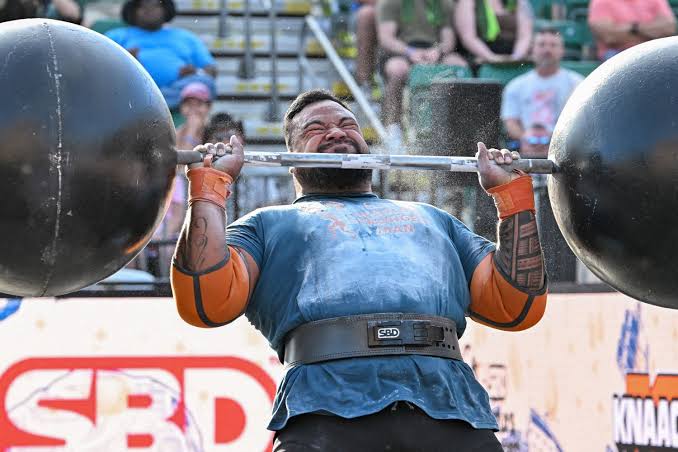
To get that log overhead, an athlete has to roll the massive cylinder up their thighs, lap it into their stomach while bent double, explosion-clean it onto their upper chest—literally crushing their own windpipe—and then drive four hundred pounds of awkward wood toward the sky until their arms lock out.
Alternatively, consider the legendary Atlas Stones. The Atlas Stones consist of five large, smooth, round balls made of solid concrete, weighing between three hundred and more than five hundred pounds. Due to the lack of handles, edges, and grip points on concrete spheres, you cannot simply lift them with your fingers.
An athlete must apply sticky tree resin to their forearms, bend down over the ball, embrace the five-hundred-pound stone against their chest like an old flame, exert pressure with their upper body until their capillaries rupture, lift it up their torso while rising, and place it over a shoulder-high platform. It’s an occurrence that strips skin from forearms, causes rib bruising, and requires every bit of power a human cardiovascular system can produce.
And then, naturally, there are the Vehicle Pulls. We are discussing securing a person in a robust leather harness connected to a forty-thousand-pound fire truck, a two-level bus, or a large commercial aircraft. The competitor seizes a heavy rope secured to the ground and pulls a mobile home across fifty feet of pavement using sheer leg power and back muscle.
When an athlete is dragging a fire truck or hoisting a five-hundred-pound rock, they aren’t merely contending with another competitor. They are fighting an intense, desperate battle against gravity, friction, and the fundamental principles of Newtonian physics.
The Shared Furnace: Why Heavy Iron Destroys the Ego
This brings us to the core psychological secret of Strongman: The weight does not care about your feelings, your trash talk, or your ego. In sports like basketball, soccer, or football, you can beat an opponent by getting inside their head, talking trash, executing a clever scheme, or getting a favorable call from a referee. You can hide behind your team, blame your coach, or pretend you were cheated by an official.
In Strongman, there are no referees to trick. There are no luck bounces. There is no trash-talking a five-hundred-pound concrete stone. If you walk up to an Atlas Stone with an inflated ego and a big mouth, but you lack the raw physical strength and technique to lift it, that stone will sit on the ground and mock you. Gravity is completely impartial, totally unyielding, and utterly indifferent to your reputation.
Because every single Strongman athlete has been pinned under a heavy log, ripped their skin open on an Atlas Stone, or collapsed in a heap of lactic acid after a heavy frame carry, they all share an intimate, visceral understanding of the suffering required to perform at that level.
They have all stood in that same dark, terrifying mental place where your lungs are burning, your vision is going black at the edges, your heart feels like it is going to explode out of your ribs, and your nervous system is screaming at you to drop the weight.
When you watch another human being walk up to a thousand-pound tire or a massive vehicle harness, you aren’t looking at an enemy to be hated. You are looking at a brother or sister who is about to enter the exact same violent furnace of physical suffering that you just walked out of. That shared suffering creates a bond that completely transcends traditional sports rivalry.
When a four-hundred-pound giant stands on the sidelines screaming at his competitor to finish a deadlift, he isn’t cheering for his own defeat. He is cheering for a fellow warrior to conquer the terrifying monster of weight sitting in front of them. He wants to see human potential win against the brutal laws of physics.
The Brotherhood of the Chalk Bucket: Real Sportsmanship in Action
To witness genuine wholesome sportsmanship, you won’t find it in a diplomatic handshake following a tense tennis match. You observe the behind-the-scenes area and the competition stage of a World’s Strongest Man event.
In every other sport, competitors protect their technical edge as if it were a classified secret. Formula 1 teams conceal their aerodynamic wing creations behind massive privacy barriers. NFL teams cancel practices to keep opponents from viewing their playbooks. Top sprinters avoid making eye contact with one another in the warm-up area prior to an Olympic final.
In Strongman, confidentiality vanishes entirely. You will frequently witness a competitor approach his direct opponent—the person who is presently in first place while he is in second—and assist him in applying sticky tacky resin to his forearms prior to the Atlas Stones. You will observe athletes exchanging personalized lifting straps, borrowing knee sleeves from one another, and offering tips on foot positioning for a challenging log lift.
As the events continue, athletes who have finished their turns do not go to their personal trailers to unwind. They stay situated exactly at the edge of the competition zone.
As a competitor battles to complete the last rep of a four-hundred-pound log press, legs quivering and teeth clenched, you will witness three of their closest rivals rushing over, pounding the mats, and shouting at full volume: “LET’S GO! SECURE IT AWAY! OPERATE! MOTIVATE! “YOU CAN DO IT!”
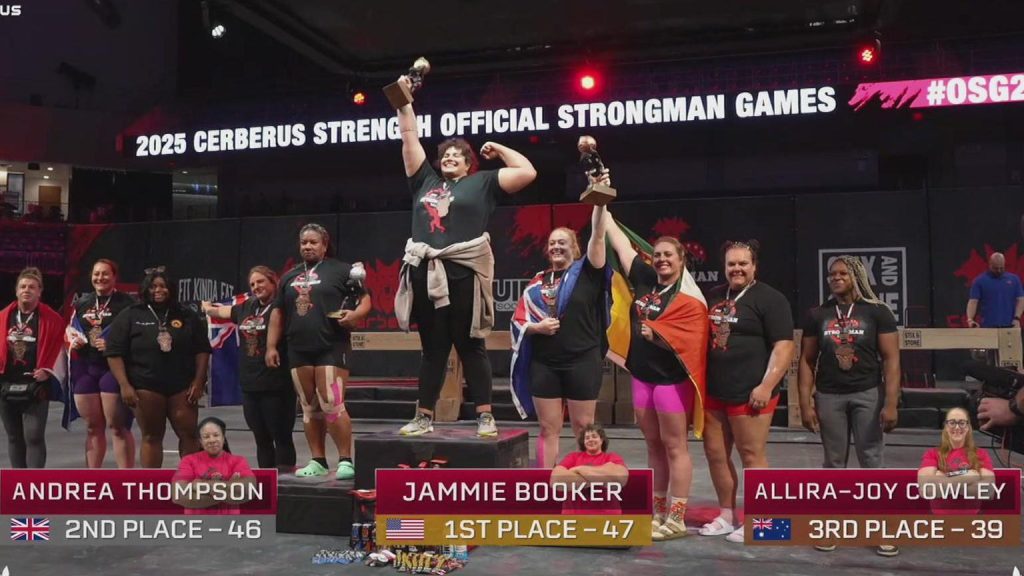
They scream until their voices become raspy. They pound their feet. They smack the athlete on the back upon completing the lift, enveloping them in huge, sweaty, four-hundred-pound bear hugs that resemble two tectonic plates crashing together. Moreover, it isn’t solely aimed at their fellow competitors; it directly involves the audience.
Strongman competitors realize that the atmosphere in the arena stimulates the human nervous system. Amidst intense efforts, these colossal figures will stroll to the arena’s edge, gesturing with their enormous arms, urging the crowd of thousands to rise and cheer for the next competitor set to enter the stage. They not only desire the audience to cheer for them; they seek the audience to scream at full volume for the person who is currently attempting to snatch the trophy from them!
It represents a total and complete reversal of contemporary sports culture. It is genuine, untainted, delightful happiness encased in four hundred pounds of muscle and facial hair.
Gentle Giants: The Disarmingly Sweet Personalities Off the Field
The difference between a Strongman’s appearance on stage and their behavior off stage is one of the most enjoyable paradoxes in human culture. When an athlete approaches a thousand-pound car deadlift, they must invoke an astonishing level of pure, instinctual fury. They hit their own faces until their cheeks turn red, they inhale smelling salts, they breathe rapidly, and they shout at the sky to boost their adrenaline levels to the max. They appear as fearsome warriors eager to demolish a house with just their hands.
As soon as the referee blows the whistle and the lift concludes, that frightening anger disappears right away, giving way to the kindest, most delightful personalities one can imagine. View an interview with a top-tier Strongman athlete following a competition.
You are observing a towering individual who has just raised a small truck, yet they communicate with quiet humility, profound gratitude, and lighthearted humor. They speak fervently about their spouses, their children, their training companions, and their pets. They chuckle often, make goofy jokes about the quantity of food needed to keep their weight, and express gratitude to the arena employees for arranging the gear. These individuals are genuinely kind giants.
Since they demonstrate their physical strength in regulated, intense conditions, they have no requirement to showcase their toughness in everyday situations. They don’t carry an attitude of resentment.
They do not see the necessity to show off, behave aggressively, or scare anyone in everyday social situations. They are confident in their power because they understand exactly what they are capable of when presented with four hundred pounds of steel. This fosters an environment where supporters can engage with these athletes in ways that are entirely unprecedented in major league sports.
In sports such as basketball or baseball, top athletes are frequently accompanied by security personnel, concealed behind velvet barriers, and swiftly taken away in black SUVs. In Strongman, following grueling, body-battering contests, these colossal competitors will remain in the rain for two hours, autographing items, taking photos, hoisting small children onto their shoulders for pictures, and conversing with fans as if they were long-time acquaintances.
They are reachable. They possess humility. They recognize just how fortunate they are to explore the globe while lifting unusual, heavy items for their career, and that appreciation is evident in all their actions.
The Psychological Prescription Our Society Needs
We exist in a society that is more and more fragmented, extremely cynical, and fixated on bringing others down. Our time is spent on online platforms created to elevate anger, showcase disputes, and set groups against one another. Our entertainment industry continuously provides us with tales of treachery, minor conflicts, and malicious drama.
A cultural reset is urgently required. We require reminders that people can exhibit great strength without resorting to extreme cruelty. This is why Strongman transcends being merely a specialized strength sport; it serves as an essential psychological remedy for today’s world.
Strongman imparts a profound insight into the essence of power. It demonstrates that true strength isn’t about dominating others, belittling your opponents, or diminishing someone else’s worth. True strength lies in strengthening yourself to confront insurmountable challenges, and then helping those around you to tackle their own challenges as well.
When observing a colossal individual using their enormous lungs to shout support at the competitor attempting to surpass them, you witness the pinnacle of human sportsmanship.
Derrick’s Hot Take: Every major sports league on Earth should be forced to take mandatory culture seminars from the Strongman community. If four-hundred-pound powerhouses who spend their afternoons dragging fire trucks across asphalt can share chalk, cheer for their rivals, and treat each other like family, then multi-millionaire athletes in other sports have zero excuse for acting like petty, trash-talking divas. Strongman proves that you can be the baddest, strongest, most terrifying athlete on the planet while still being a thoroughly decent, incredibly wholesome human being.
The Eternal Lift
In the end, the weighty iron will consistently be present. Another five-hundred-pound stone will always be on the ground, another large log will be there to be pushed, and another heavy vehicle will be ready to be dragged across the threshold. The physical boundaries of human muscle, bone, and determination will keep being challenged by enormous men and women striving to reach the very edge of what is biologically feasible.
As long as Strongman as a sport continues, those heavy weights will be lifted in a setting filled with unwavering support, contagious enthusiasm, and deep mutual respect.
The competitors will keep slapping each other on the back, they will keep sharing lifting equipment, they will keep shouting until their voices are gone for their fellow athletes, and they will keep treating each other to huge meals when everything is over.
When you feel exhausted by the trivial drama and harsh clamor of contemporary sports, mute the loud announcers, start a Strongman competition, and observe the kind giants in action.
Be amazed by the science, admire the immense physical force, absorb the pure and positive energy, and recall that genuine strength is most beautiful when it’s devoted to uplifting one another.