The Last of Us: Why the Best Episode Was the One That Ignored the Game
Let’s visit late January 2023 again. HBO’s version of The Last of Us had been airing for three weeks, and the cultural buzz was already reaching a loud crescendo. Gamers were nearly ecstatic.
The initial two episodes provided an impressively accurate, almost photographic adaptation of Naughty Dog’s 2013 video game masterpiece. We witnessed the destructive outbreak night in Austin, the fungal cordyceps crackling in the darkness of a shattered Boston, and Pedro Pascal’s Joel wearing the famous brown jacket while Bella Ramsey’s Ellie hurled sharp retorts from beneath her dark red hoodie. It was seamless, lavishly produced, nostalgia-driven moment for moment. It felt secure.
Then arrived Episode 3: “Long, Long Time.” For seventy-five minutes, creators Craig Mazin and Neil Druckmann executed an action that resonated powerfully within the fandom. They successfully hit “pause” on the central narrative momentum of the whole season.
They placed Joel and Ellie in the rear of their own narrative, fully stepped beyond the limits of the original content, and gave the microphone to two secondary characters who, in the game, mainly functioned as plot devices to provide the player with a pickup truck, a shotgun, and several nail bombs.
Rather than an hour filled with intense action, stealthily avoiding Infected, and chaotic shootouts in a rigged town, we received a gentle, poignant, heartbreaking love narrative spanning decades between a wary, armed survivalist called Bill (Nick Offerman) and a warm-hearted artist named Frank (Murray Bartlett).
The internet, predictably, fractured down the middle. One side hailed it as a landmark masterpiece of television drama, an instant classic that transcended the zombie genre. The other side complained that it was “filler,” an unnecessary detour that broke the momentum of the show and didn’t push the “main plot” forward.
If you belong to that second camp, I’m going to be entirely direct with you: you missed the point of The Last of Us altogether. “Long, Long Time” is not a distraction from the core story. It is the thematic heart of the entire series. It is the single moment where the HBO series broke free from “The Adaptation Trap”—the fatal delusion that a great video game adaptation must blindly mimic the gameplay loop of its source material—to deliver a piece of storytelling that translated the game’s core philosophical thesis far better than a beat-for-beat recreation ever could.
Part I: Why Direct Transfers Fail
To grasp why Episode 3 is a complete success, we must first discuss what I refer to as The Adaptation Trap, a flaw that has ensnared ninety percent of video game films and series in the past three decades. Video games and television are inherently distinct artistic forms that function on completely contrasting narrative mechanisms.
A video game relies on player agency and immersion via its mechanics. Playing The Last of Us on a PlayStation console allows you to connect with Joel and Ellie as you ensure their physical safety. You sense the world’s lack as you search through vacant desk drawers for scissors and duct tape. You dread the Clickers as you grip the controller with clammy hands, straining to hear footsteps in the shadows. The action scenes in a game are not merely for show; they serve as the interactive glue that bonds the character relationships.
When you remove the controller and display that narrative on a TV screen, the interactive element vanishes entirely. If a television series tries to reproduce ten hours of stealthily evading guards, creating health packs, and shooting infected individuals in corridor after corridor, it quickly becomes monotonous within three episodes. What seems intense and exciting while gripping a controller feels vacant, lifeless, and draining when you are simply observing from a couch.
My Take: The worst mistake a video game adaptation can make is prioritizing mechanical fidelity over thematic resonance. A literal translation of game events gives fans a checklist of recognizable moments; an artistic translation gives them the feelings those moments were meant to evoke in the first place.
This was the quiet crisis facing Craig Mazin and Neil Druckmann when they reached the “Bill’s Town” chapter of the story. In the 2013 game, Bill’s section is a brilliant piece of level design. It’s a tense, action-heavy sequence where Joel and Ellie navigate a town covered in tripwires, fight off waves of infected, run from an armored truck, and eventually find the hanged corpse of Frank—Bill’s former partner, who left a bitter, resentful suicide note stating he hated Bill’s guts and preferred dying alone to spending another day with him. In the game, Bill is a tragic warning sign for Joel: a bitter, lonely paranoid hermit who survived, but lost his humanity in the process.
It works wonderfully in a game. But on television? Repeating that structure would have yielded just another standard, episodic monster-of-the-week action detour. Instead of asking, “How do we recreate this video game level?” Mazin and Druckmann asked the far more profound question: “What is this chapter actually trying to say about love and survival, and how do we say it using the unique strengths of prestige television?”
Part II: The Paranoid and the Artist
The clever risk of “Long, Long Time” rests in its readiness to decelerate time and focus closely on two lives that would typically be regarded as mere background in a post-apocalyptic story.
The episode begins in 2003, right after the outbreak occurs. Bill is in his zone. He is a dedicated, anti-government survivalist—a person who has devoted his whole adult life to getting ready for the apocalypse. As the remainder of his town faces evacuation (and later execution) by FEDRA military troops, Bill relaxes in an underground bunker, watching surveillance feeds, sipping wine, and laughing at the downfall of society.
As the military departs, Bill emerges into a deserted town and creates his own sanctuary. He installs gas lines, constructs electric fences, sets up automated gun turrets, gathers a stockpile of military arms, and indulges in exquisite meals made from foraged gourmet ingredients.
For Bill, the end of the world is not a disaster; it’s a triumph. He is secure. He is completely self-reliant. He relies on no one, has faith in no one, and is indebted to no one. He has constructed an invulnerable stronghold of solitude.
Four years later, Frank ends up in one of his pit traps. The first meeting of Nick Offerman’s Bill and Murray Bartlett’s Frank showcases an exceptional display of subtle, layered acting. Bill points a shotgun at Frank, considering him a danger. Frank, famished and weary, craves a hot meal and a bath.
As Bill hesitantly permits him to enter, a magical event occurs. Frank spots an old piano located in the corner of the living room. He takes a seat, opens a songbook, and fumbles through a rough version of Linda Ronstadt’s “Long, Long Time.”
Bill, visibly pained by Frank’s terrible playing, gently takes his place at the keys. And then, Nick Offerman—a man best known for playing the stoic, mustache-touting Ron Swanson in Parks and Recreation—sings the song with a raw, tremulous, emotionally naked vulnerability that shatters the entire screen: “Love will abide, take things in stride / Sounds like good advice, but there’s no one at my side / And time washes clean, love’s golden chain / It’s sweet memory always remains…”
In that single moment, the entire tragedy of Bill’s existence is laid bare. He hasn’t been surviving because he loves life; he has been surviving because he was terrified of letting anyone close enough to hurt him. He was a dead man hiding inside an armory.
Frank recognizes this instantly. He leans down, kisses Bill, and in a matter of minutes, two decades of isolation dissolve into the start of a profound, beautiful, life-saving partnership.
Part III: Love as a Radical Act in a Broken World
What makes the central relationship in Episode 3 so emotionally overwhelming is how it redefines the concept of “survival” in a post-apocalyptic setting. Most post-apocalyptic fiction is obsessed with the idea that survival requires turning yourself into a monster. It tells us that the world belongs to the cruel, the selfish, and the pragmatic. If you care about people, you die. If you show mercy, you get betrayed.
“Long, Long Time” completely rejects that cynical premise. It argues that survival without human connection is not survival at all—it’s just delayed rot.
Look at how Frank transforms Bill’s sterile, paranoid fortress over the next twenty years. Frank doesn’t care about tactical redundancies or ammo counts. He cares about beauty, community, and joy.
- Frank insists on painting the dining room walls.
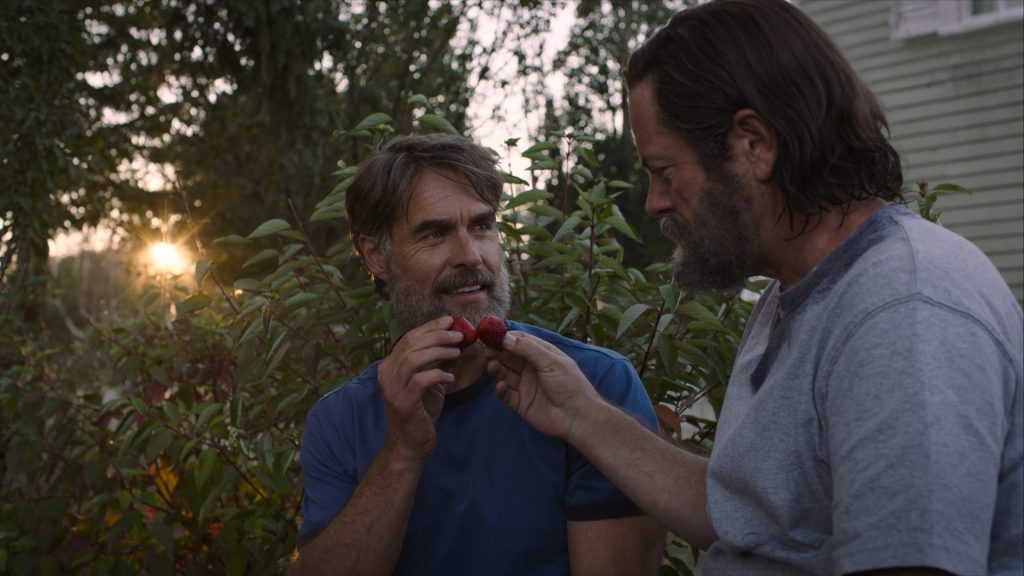
- Frank trades one of Bill’s prized guns for strawberry seeds so they can build a small garden.
- Frank cleans up the surrounding street, fixing up the dilapidated storefronts so they have a charming neighborhood to walk through.
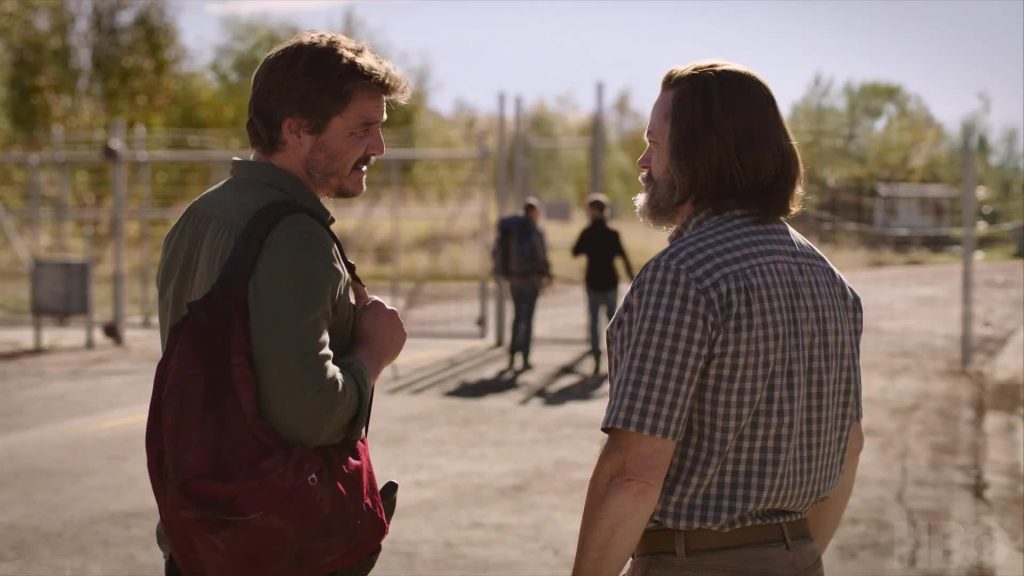
- Frank secretly communicates over the radio with Tess and Joel, inviting them over for lunch because he realizes that two human beings cannot exist in total isolation without going insane.
At every step, Bill resists. He complains about the wasted resources, the security risks, the pointlessness of aesthetics when the world outside their fence is infested with monsters and raiders.
Yet, watch Nick Offerman’s face when Frank hands him a fresh, home-grown strawberry in the middle of their garden. Bill tastes it, laughs with childlike delight, and realizes that Frank was right all along. The fences, the guns, the traps—none of it meant anything until there was something inside the perimeter worth protecting.
The Shift: In a world governed by death, decay, and fungal consumption, growing strawberries and painting a storefront is not foolish. It is an act of fierce, uncompromising rebellion. It is a refusal to let the world turn you into stone.
This dynamic challenges the dominant philosophy of Joel Miller’s character. Joel, up to this point in the series, is a man who has closed off his heart entirely following the loss of his daughter Sarah. He survives through sheer, cold-blooded violence and emotional detachment. He views Ellie not as a girl, but as “cargo.”
By showing us the contrast between Bill’s cold survivalism and his warm, transformed life with Frank, the show quietly sets up the central philosophical battle that Joel will have to fight for the rest of the season.
Part IV: The Double-Edged Sword
Nonetheless, Craig Mazin and Neil Druckmann are much too intelligent to create a straightforward, sweet fairy tale. “Long, Long Time” doesn’t assert that love resolves every issue or that it mystically eliminates the harsh truths of the Wasteland.
Rather, the episode reveals the core tragedy of human relationships in a fractured world: love is simultaneously the sole reason life is meaningful AND the greatest risk an individual can have.
This theme becomes frighteningly clear during a midnight downpour midway through the episode. A band of raiders tries to penetrate the town’s boundary fence. Bill, hearing the robotic turrets shooting, dashes outside in his bathrobe with a sniper rifle to protect his house.
During the following gun battle, Bill is wounded in the stomach. Frank pulls his wounded, moaning body inside, placing him on the dining table as Bill struggles to breathe, certain he is about to die.
In that instant of dying, Bill does not gaze at his weapons or his provisions. He gazes at Frank, frightened—not of death itself, but of what will become of Frank if he is abandoned in this world.
After several years, the positions change. As time goes by, grey hair appears, and Frank acquires a degenerative condition (suggested to be ALS or Parkinson’s) that confines him to a wheelchair, causes him ongoing pain, and gradually takes away his independence.
Bill, now a senior man, takes on the responsibilities of a full-time caregiver. He ground the medicine, assists Frank in getting up, paints alongside him, and looks after him with a strong, silent commitment.
This is where the episode reaches its ultimate emotional weight. The threat in “Long, Long Time” is not the cordyceps fungus. There are no Clickers in this episode after the early flashback scenes. The enemy here is time, disease, and the inevitability of human mortality—enemies that no shotgun or electric fence can ever defeat.
Frank’s body is failing, and he decides he wants to end his life on his own terms before the pain becomes unbearable. He asks Bill for “one last good day.”
They dress up in suit jackets. They walk through their town. They get married in their living room with makeshift rings. They eat a delicious final meal. And then, Frank drinks a glass of wine laced with a lethal dose of crushed sleeping pills.
And then comes the twist that elevates this episode into the stratosphere of television writing. Bill takes a sip from his own wine glass. Frank looks at him in shock, realizing what he has done. Bill looks back at him with a soft, peaceful smile and says: “This isn’t a tragic suicide pact. I’m old. I’m satisfied. And you were my purpose.”
Bill chose to die not out of despair, but out of total completion. He had fulfilled his mission. He had protected the person he loved, lived a full, rich, beautiful life in the middle of an apocalypse, and refused to go back to existing in an empty, quiet house. They walk into their bedroom, close the door, and pass away together in peace.
Part V: How Episode 3 Informs Joel’s Final Choice
This brings us to the moment where “Long, Long Time” seamlessly loops back into the main narrative arc of Joel and Ellie, delivering an emotional payoff that echoes across the rest of the series.
A few days after Bill and Frank’s death, Joel and Ellie arrive at the quiet, empty town. They find the house locked, the truck ready, and a letter left on the dining room table addressed to “Whomever, but probably Joel.”
Ellie reads the letter aloud to Joel while he gathers supplies. Bill writes about his philosophy of life, leaving behind a stark, prophetic message for his fellow survivor: “I used to hate the world and I was glad when everyone died. But I was wrong. Because there was one person worth saving. That’s what I did. I saved him. And I protected him. That’s why men like you and me are here. We have a job to do. And God help any motherfuckers who stand in our way.”
Watch Pedro Pascal’s performance as Ellie reads those words. You can see the emotional armor cracking behind his eyes. In the video game, Bill’s chapter serves as a negative warning: If you keep pushing people away, Joel, you’re going to end up like Bill, bitter, angry, and alone in a town full of traps.
In the HBO series, Bill’s story serves as a positive blueprint: Men like us are built to protect someone. You cannot survive alone, Joel. You need a purpose, and that girl sitting in the passenger seat of your truck is your second chance.
Without Episode 3, Joel’s eventual transformation throughout the season—his gradual willingness to open his heart to Ellie, to become a father again, and ultimately to commit an unspeakable, horrifying act of violence at the Salt Lake City hospital to save her life—lacks its foundational emotional spine.
Bill’s letter gives Joel explicit permission to love again. It tells him that in a world that has lost its mind, protecting a single human being is the only sacred duty left. When Joel makes his fateful, monstrous choice in the season finale, he is executing the exact philosophy that Bill laid out on that dining room table: God help any motherfuckers who stand in our way.
Part VI: The Visual Syntax aka. The Open Window
To understand the sheer artistic brilliance of how “Long, Long Time” ends, look at the final shot of the episode. After Joel and Ellie take Bill’s truck and drive away down the open highway—setting off toward the rest of their journey with a new sense of purpose—the camera slowly recedes back into Bill and Frank’s house.
It glides down the hallway, moves through the master bedroom, and settles on an open window. The curtains are blowing softly in the warm afternoon breeze. Through the window, we can see the quiet, sunlit street of their town, peaceful and still. That open window is a masterclass in cinematic symbolism.
In the pilot episode of The Last of Us, windows are depicted as points of terror—they are where infected break through, where glass shatters, where the world comes crashing in to destroy your family.
In Episode 3, the open window is an invitation. It signifies that Bill and Frank didn’t die in fear behind locked shutters and reinforced steel. They died with the window wide open, letting the air, the light, and the world inside, because they had conquered their fear through love. It is an image of absolute peace in a universe defined by chaos.
The Verdict: Fidelity to Spirit Over Fidelity to Pixels
When discussing the history of video game adaptations, a clear distinction will always exist between before and after January 29, 2023. Prior to “Long, Long Time,” Hollywood thought that turning a video game into a film involved replicating its visual elements, imitating its action scenes, and ensuring the characters donned the same outfits as their digital versions. It was a sector motivated by superficial admiration and artistic timidness.
Craig Mazin, Neil Druckmann, Nick Offerman, and Murray Bartlett demonstrated that genuine fidelity demands a significantly bolder approach. They understood that the main purpose of an adaptation isn’t to present you with the same visuals you viewed on a screen long ago; rather, it is to evoke the same deep, powerful human emotions that initially drew you to the narrative.
By diverting from the gameplay, pausing the action, and narrating a subtle, seventy-five-minute love story about two aging men sharing their lives in a deserted town, The Last of Us achieved a modern television masterpiece. It demonstrated that love during an apocalypse is neither a luxury, nor a mistake, nor a flaw. That’s the entire purpose.