Can a New Rapunzel and Flynn Save Disney’s Next Era of Remakes?
We all knew it was coming. Like an unstoppable, multi-billion dollar wave, Disney’s live-action film machine has finally set its sights on the jewel of modern Disney’s revival: Tangled.
Let’s be honest with ourselves. The announcement that Disney was actively developing a live-action version of the 2010 animated masterpiece didn’t just spark the usual online complaints. It triggered a full-blown existential crisis for a generation of moviegoers.
For those of us who watched Disney stumble across the dry, photographic prairies of The Lion King (2019) or squint through the eerie, dim underwater light of The Little Mermaid (2023), the idea of touching Tangled no longer felt like a delightful nostalgic ride but a risky gamble.
But then news of the casting call broke in early 2026, and the internet exploded. With Teagan Croft (Titans) officially donned the purple dress and Milo Manheim (Zombies) taking on Eugene Fitzherbert (aka Flynn Rider), Disney had publicly revealed its plans. Behind the scenes, we have Michael Gracey (The Greatest Showman) in the director’s chair and Jennifer Kaytin Robinson (Do Revenge) writing the script.
In theory, it’s a fascinating, dynamic combination of the energy of kids who love the stage, edgy superheroes, flashy music, and a sharp, modern script. But can this team pull off the impossible?
Can they capture the magical, expressive magic of a film that saved Walt Disney Animation Studios from a decade of identity crisis? Or are we about to witness another beloved classic transformed into a beautifully crafted, expensive, yet ultimately soulless live-action adaptation?
Sit down, grab your frying pan, and let’s analyze why this remake is a crucial milestone for Disney’s future. Let’s see if our new Rapunzel and Flynn are capable of saving it.
The Elephant in the Tower: The “Impossible” Expressive Challenge
To understand why a live-action version of Tangled is such a terrifying prospect, you have to understand the ingenuity of the original 2010 animation. Tangled is a princess film that became the absolute pinnacle of Disney’s transition from traditional hand-drawn animation to computer-generated 3D (CGI) imagery.
Legendary animator Glen Keane, who was responsible for drawing Ariel, the Beast, and Aladdin, spent years developing a technique that allowed the 3D models to retain the warmth, fluidity, and extreme “stretchability” of 2D hand-drawn art. The result is a film where the characters’ faces not only move; they sing.
Rapunzel’s large, emerald-green eyes convey a range of intense, overwhelming emotions in a single second. She transitioned from existential fear to pure, unadulterated joy, with a facial expression only achievable in animation.
And Eugene? The legendary “hot man meeting” is a piece of Disney lore for a reason. The creative team literally brought a room full of women together to critique and design the ultimate, highly expressive, roguishly handsome lead. Every smirk, every raised eyebrow, and every subtle micro-expression on Eugene’s face was micro-targeted for maximum charm.
This brings us to the fundamental paradox of Disney’s live-action remakes: the “uncanny valley” of realistic performance.
When you take a character designed around exaggerated, hyper-expressive proportions and force a real human actor to replicate them, one of two things usually happens:
- The performance becomes cartoonishly jarring because a real face trying to match hand-drawn energy looks bizarre.
- The performance becomes emotionally flat because real human faces are physically incapable of matching the sheer, unrestrained emotional range of a hand-drawn caricature.
Think back to the live-action Beauty and the Beast (2017). Emma Watson is a lovely actress, but her Belle lacked the sweeping, theatrical scale of her animated counterpart, often looking mildly bemused where she should have been terrified or enchanted. If Teagan Croft and Milo Manheim are directed to give “grounded, realistic” performances, Tangled loses its heartbeat. The entire movie relies on an infectious, theatrical, almost exhausting level of emotional energy.
Teagan Croft as Rapunzel: From Gritty Hero to Golden Hair
Let’s start with our new lost princess.
Actor: Teagan Croft
Best Known For: Rachel Roth / Raven on DC’s “Titans”
Vibe Check: Deep, introspective, potentially gritty, but possessing an undeniable, piercing emotional intensity.
When Teagan Croft’s casting was announced, a lot of casual Disney fans went, “Who?” But for those of us who spent years watching the gritty, moody world of DC’s Titans on Max, the reaction was a mix of shock and profound curiosity.
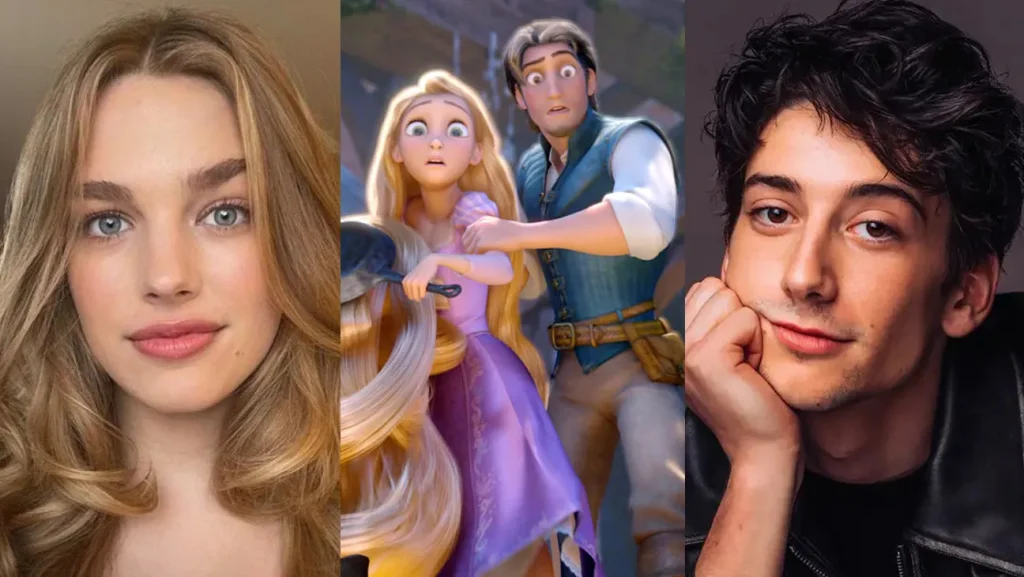
As Rachel Roth (Raven), Croft spent five seasons playing a deeply traumatized, gothic teenager harboring an ancient, world-destroying demon inside her. It was a role defined by quiet intensity, shadows, internal torment, and very dark makeup. To go from that to Rapunzel, a literal ray of sunshine who has spent 18 years painting murals, baking paper-mache, and singing to a chameleon, is one of the wildest career pivots in recent memory.
But here is why I actually think this casting is low-key brilliant: Croft understands how to act with her eyes. If you watch her performance in Titans or her turn in Netflix’s survival drama True Spirit, Croft has an incredibly expressive gaze. In Titans, even when the script was letting her down, she could convey massive amounts of vulnerability, fear, and resolve without saying a single word. That is a crucial skill for Rapunzel.
Remember, Rapunzel is not just a bubbly optimist. She is a victim of severe psychological abuse and gaslighting at the hands of Mother Gothel. She has spent her entire life locked in a stone cylinder, told that the outside world is a terrifying wasteland of monsters and thieves.
When she finally steps onto the grass for the first time during the song “When Will My Life Begin? (Reprise)”, she goes through a literal manic-depressive cycle in the span of two minutes, joyously running through a meadow, followed immediately by weeping over her betrayal of her mother.
“Rapunzel isn’t just a cheerful princess. She’s a survivor of long-term isolation trying to process an overwhelming sensory overload. If you don’t ground her manic energy with real, palpable vulnerability, she just comes off as annoying.” — Marc
Croft has the dramatic chops to sell the darker, more emotional undercurrents of Rapunzel’s journey. The real test will be whether she can shed the brooding, internal weight of her past roles and tap into the bubbling, uninhibited joy that defines the character.
We need to see her swing from rafters, get excited about pub thugs, and look at the floating lanterns with an expression of pure, child-like wonder. If she can pull off that emotional range, she might just deliver one of the most multi-dimensional live-action princesses we’ve ever seen.
Milo Manheim as Flynn Rider: Can the Disney It-Boy Get Gritty?
And now, we have to talk about the Smolder. If Teagan Croft’s casting was an intriguing curveball, Milo Manheim’s casting as Flynn Rider was a lightning rod for internet skepticism.
Actor: Milo Manheim
Best Known For: Zed in Disney’s “Zombies” franchise
Vibe Check: Hyper-charismatic, Broadway-caliber triple threat, but carrying a heavily polished, Disney Channel pedigree.
Manheim is Disney royalty. As the lead of the insanely popular Zombies musical franchise, he has spent years as the absolute darling of the younger demographic. The guy is a powerhouse performer: he can sing, he can dance (he was a runner-up on Dancing with the Stars), and he exudes a high-energy, theater-kid charisma that is impossible to ignore.
But Flynn Rider is a very specific type of character. Flynn is a cynical, self-serving, incredibly dry-witted thief in his mid-to-late twenties. He’s a guy who has lived on the streets, survived on his wits, and built up a massive, theatrical wall of fake charisma to hide his deeply insecure inner orphan, Eugene Fitzherbert. He is supposed to have a rugged, slightly dangerous edge to him.
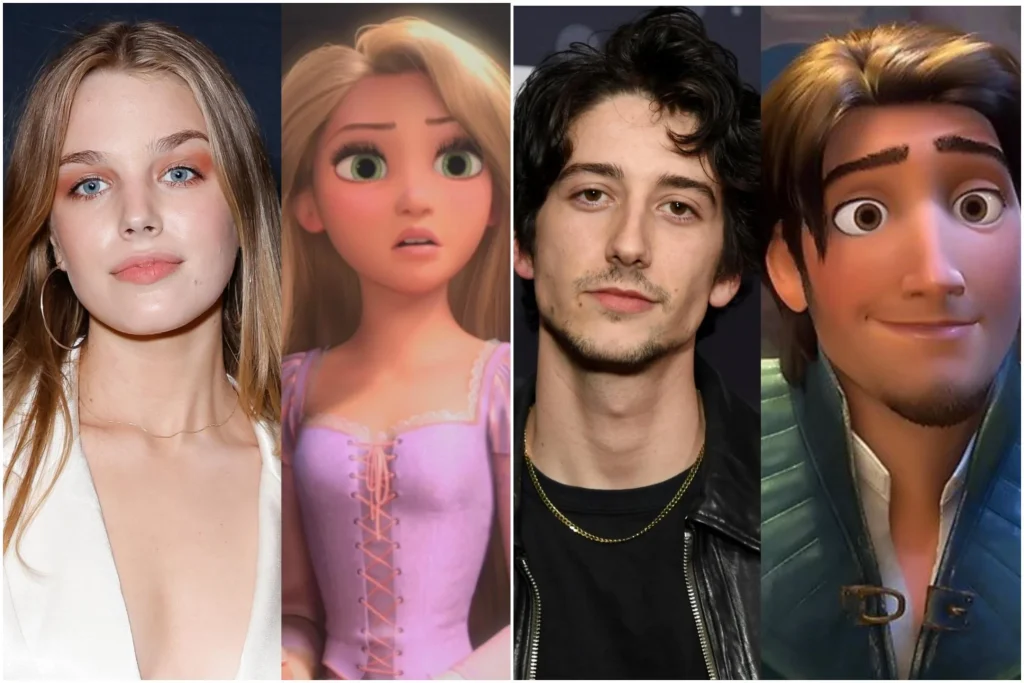
When fans look at Milo Manheim, they see an incredibly handsome, clean-cut, energetic 24-year-old who looks like he’s about to break into a high school pep rally song. There is a legitimate fear that Manheim’s version of Flynn will be too sanitized, too “Disney Channel,” and lacking the sardonic, adult-in-the-room energy that Zachary Levi brought to the animated original.
However, let’s play devil’s advocate here. If you’ve seen Manheim perform live or watched his work outside of the Zombies films (such as his run in Off-Broadway theater), you know the guy has serious theatrical gravity. He is a genuine, old-school showman. And when you think about Flynn Rider, what is he if not a showman? Flynn is literally playing a character within the movie. His entire “Flynn Rider” persona is a performance he puts on for the world.
Manheim absolutely has the physical charisma and the comedic timing to pull off Flynn’s theatrical arrogance. He can do the physical comedy, the swordplay, and the bantering with a CGI horse.
The real challenge for Manheim will be toning down the polish. He needs to find the dirt under Flynn’s fingernails. He needs to play the quiet, quiet moments like the campfire scene where he reveals his real name, Eugene with a raw, understated sincerity that makes us forget he’s a Disney Channel star. If he can balance his natural, show-stopping charisma with a genuine, grounded vulnerability, he might actually shut up the doubters and redefine what a live-action Disney male lead can be.
The Ultimate Weapon: Kathryn Hahn as Mother Gothel
While the internet was busy debating Rapunzel’s hair and Flynn’s smolder, Disney quietly made what might be the single greatest casting decision in the history of live-action remakes: Kathryn Hahn as Mother Gothel. Let’s not mince words here. This is an absolute masterclass in casting.
Gothel is one of Disney’s most complex villains because her evil is so domestic, so recognizable. She doesn’t want to conquer the world; she just wants to stay young, and she is perfectly willing to destroy a young girl’s mental health to do it. She plays the martyr, she subtly insults Rapunzel’s appearance under the guise of “protection,” and she uses guilt as a physical weapon.
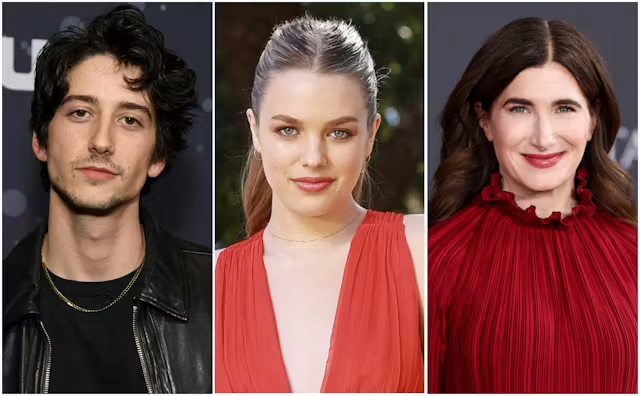
Hahn is going to eat this role alive. She has the exact comedic timing needed to make Gothel’s dramatic mood swings hilarious, but she also possesses the dramatic depth to make her truly terrifying when the mask slips. When Gothel realizes she is losing control of Rapunzel, the shift from maternal smothering to cold, calculating villainy needs to feel dangerous. With Hahn, we are guaranteed a villain who will command every single second of screen time she is given.
Michael Gracey & Jennifer Kaytin Robinson: The Creative Gamble
Of course, great casting means absolutely nothing if the creative vision behind the camera is uninspired. Fortunately (and perhaps a little terrifyingly), the creative team behind this film is anything but safe.
The Director: Michael Gracey
Directing a live-action musical is one of the most difficult tightropes in Hollywood. If you make it too realistic, the singing feels jarring and out of place (think Les Misérables). If you make it too theatrical, it feels like a filmed stage play.
Enter Michael Gracey. As the director of The Greatest Showman, Gracey proved that he knows exactly how to shoot modern, high-energy musical sequences. He doesn’t do boring, static camera setups. He uses sweeping camera movements, hyper-dynamic choreography, and vibrant, saturated color palettes.
This is exactly what a live-action Tangled needs. Tangled is a story of movement—Rapunzel swinging from her hair, the chaotic barroom brawl of “I’ve Got a Dream,” the dizzying, romantic dance through the streets of the kingdom. Gracey’s style is the perfect antidote to the flat, gray, “realistic” aesthetic that has plagued so many recent Disney remakes. He understands that a musical needs to feel like a spectacle.
The risk, of course, is that Gracey sometimes prioritizes style over substance. The Greatest Showman was a visual and auditory feast, but its storytelling was incredibly thin. Tangled is a beautifully structured screenplay; it cannot afford to lose its emotional core in favor of flashy edits and pop-music sensibilities.
The Screenwriter: Jennifer Kaytin Robinson
That is where Jennifer Kaytin Robinson comes in. Robinson is one of the sharpest, wittiest voices in modern screenwriting. As the writer-director of Netflix’s dark comedy hit Do Revenge and a co-writer on Marvel’s Thor: Love and Thunder, Robinson specializes in writing razor-sharp, fast-paced, highly cynical but ultimately emotional dialogue.
Putting her in charge of the script is an incredibly exciting choice. Tangled’s original screenplay (written by Dan Fogelman) succeeded because it felt modern, snappy, and self-aware without devolving into obnoxious meta-humor. Robinson has the exact pen needed to update that dialogue for a 2020s audience.
She can sharpen the banter between Rapunzel and Eugene, give Mother Gothel’s psychological warfare an even more biting edge, and ensure that the film’s pacing remains incredibly tight. If she and Gracey can find the perfect harmony between sharp, modern writing and grand, theatrical romanticism, they might actually create a screenplay that justifies this remake’s existence.
Why the “Tangled” Timeline Actually Works
One of the biggest issues with Disney’s recent live-action slate has been the sheer speed of the remake cycle.
When Disney announced a live-action Moana, the collective response was a massive eye-roll. The original Moana came out in 2016; a live-action remake arriving barely a decade later feels less like a celebration of a classic and more like a cynical, rushed cash grab. There is no time for nostalgia to mature.
Tangled, however, occupies a very different space on the timeline.
- 2010: Original animated film releases, grossing $590+ million and kickstarting the Disney Revival.
- 2017-2020: Rapunzel’s Tangled Adventure animated series expands the lore, building a massive, dedicated cult following among younger millennials and Gen Z.
- 2026-2028 (Estimated): The live-action film is slated to hit theaters.
By the time this film actually reaches theaters, nearly 18 years will have passed since we first saw Rapunzel step out of her tower.
That is a crucial gap. The kids who watched Tangled in theaters in 2010 are now in their late twenties and early thirties. They are starting families of their own, or at the very least, they are experiencing the heavy, sweet pull of childhood nostalgia. Tangled has had actual, legitimate time to become a classic. It has lived in our culture long enough for a remake to feel like a revisit rather than a re-run.
The CGI Nightmare: Maximus and Pascal
We cannot talk about Tangled without talking about its true scene-stealers: Maximus and Pascal.
In the animated film, Maximus (the palace horse who behaves like a bloodhound) and Pascal (the fiercely protective, silent chameleon) are comedic gold. They are silent characters whose entire appeal relies on highly stylized, 2D-inspired physical comedy. Maximus fights with swords in his mouth, sniffs the ground like a dog, and engages in epic staring contests with Flynn. Pascal communicates entirely through rapid-fire color changes and aggressive eye-rolls.
This is where Disney’s live-action remakes traditionally go to die. Remember Flounder and Sebastian in the live-action The Little Mermaid? In an attempt to make them look like “real” sea creatures, Disney stripped them of all facial expressions, turning beloved, expressive characters into creepy, dead-eyed, photo-realistic nightmares.
If Michael Gracey goes the photo-realistic route with Maximus and Pascal, the movie is dead on arrival.
“You cannot have a photo-realistic, National Geographic-style horse wielding a frying pan in his teeth. It doesn’t look cool; it looks like a glitch in the simulation.” — Marc
Gracey and his VFX team must embrace a stylized, expressive approach to these animal characters. They need to look real enough to share a frame with Teagan Croft and Milo Manheim, but they must retain their expressive, cartoonish physical comedy. If Maximus cannot smirk, and if Pascal cannot look utterly exhausted by Eugene’s antics, then the heart of the film’s comedy is completely gutted.
Will It Save the Era of Remakes?
Disney is at a fascinating crossroads. The initial novelty of the live-action remake has officially worn off. Audiences are no longer willing to show up to theaters just to see a shot-for-shot, less colorful replication of a movie they already own on Blu-ray.
For the live-action Tangled to succeed, it cannot just copy the 2010 film. It has to use the medium of live-action to explore the story in a way that animation couldn’t.
- It needs to lean into the theatricality of the music, treating the musical numbers like grand, cinematic spectacles rather than realistic dramas.
- It needs to lean into the psychological depth of Rapunzel’s captivity and Gothel’s manipulation, giving Teagan Croft and Kathryn Hahn the space to play a genuinely complex, emotional mother-daughter dynamic.
- It needs to let Milo Manheim be the incredibly charismatic, fast-talking, physical performer he is, while letting Jennifer Kaytin Robinson sharpen his dialogue to a razor-sharp point.
If the creative team can do that—if they can balance the sweeping romance of the lantern scene with a snarky, modern wit and a bold visual style—then Tangled won’t just be another remake. It could actively save Disney’s next era of films, proving that these live-action adaptations can actually be legitimate, thrilling pieces of cinema in their own right.
It’s a massive tower to climb. But with this cast and this crew, I might actually be willing to let my hair down and hope for the best.
What do you think? Are you sold on Teagan Croft and Milo Manheim, or is this one remake Disney should have left locked away in the tower? Drop your thoughts in the comments below!